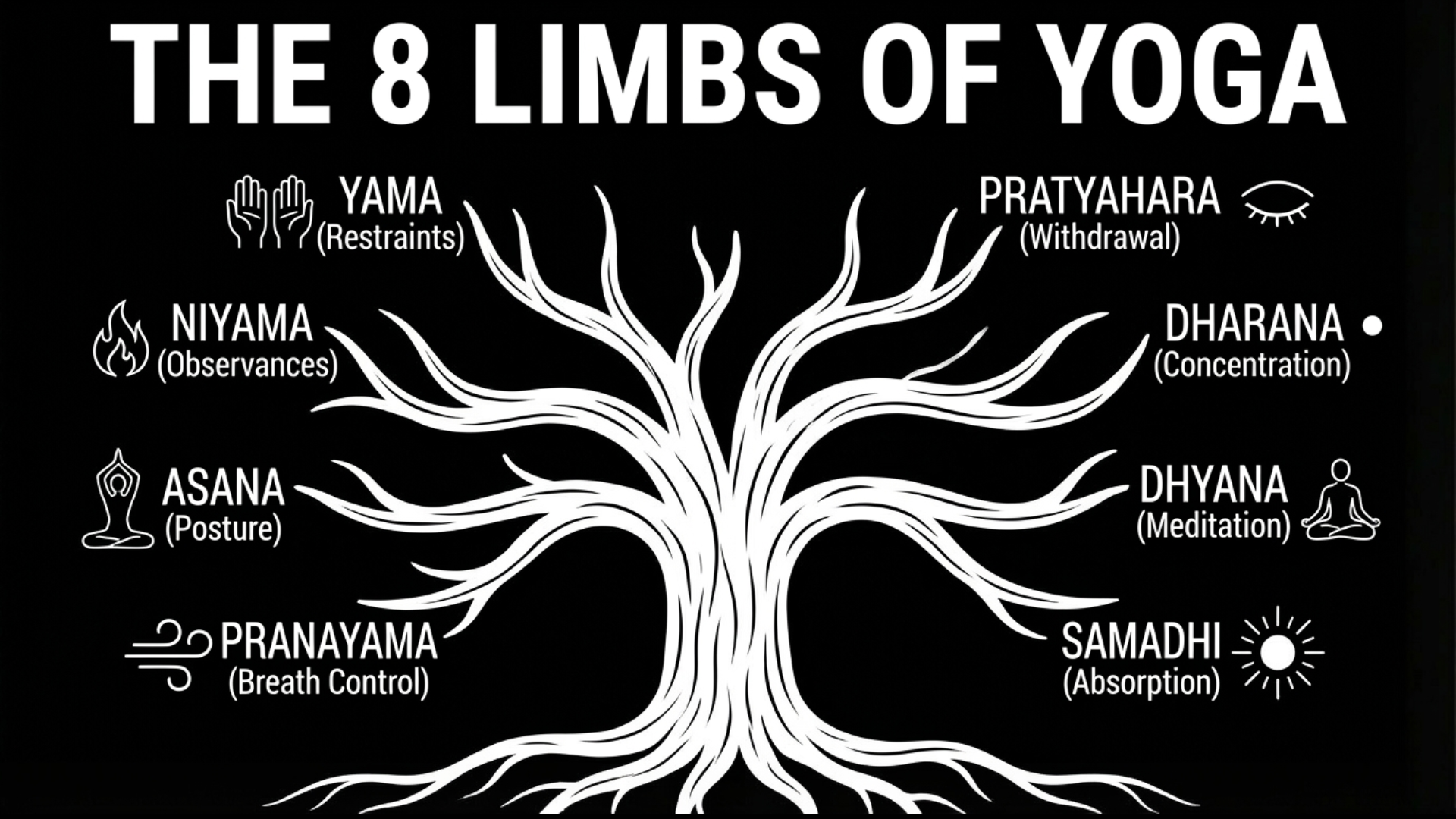
The 8 Limbs of Yoga: A Path to Freedom
When most people think of yoga, they picture flexibility, balance, and perhaps some impressive poses shared on social media. But the physical postures we associate with yoga represent just one small piece of a much larger philosophy. According to Patanjali's Yoga Sutras, there exists an eight-fold path leading to liberation, known as the Ashtanga Yoga System or the 8 Limbs of Yoga.
The word "yoga" itself means unity, to connect. What we're connecting to is our true Self, the divine essence within us. Alternatively, yoga can mean separation or disentanglement from whatever prevents us from feeling free. The ultimate goal of any yoga practice is to attain moksha, meaning liberation or freedom.
The Eight-Fold Path
1. Yama - Moral Disciplines
The first limb concerns our relationship with the world around us and how we interact with it. There are five Yamas: Ahimsa (non-violence), Satya (truthfulness), Asteya (non-stealing), Brahmacharya (right use of energy), and Aparigraha (non-greed).
Yoga extends far beyond the mat. If we can learn to be kind, truthful, and use our energy wisely, we benefit not only ourselves but everything and everyone around us. These principles are unconditioned by time, class, and place, meaning anyone can practice them regardless of background or experience.
2. Niyama - Positive Duties
The second limb refers to internal duties, with the prefix "ni" meaning "inward" or "within." The five Niyamas are: Saucha (cleanliness), Santosha (contentment), Tapas (discipline), Svadhyaya (self-study), and Isvarapranidaha (surrender to a higher power).
These practices are intended to build character and guide us from the physical aspects of ourselves toward the truth within.
3. Asana - Posture
Here's where many people get surprised. The word asana doesn't refer to complex poses or impressive backbends. It means "seat," specifically the seat you would take for meditation. The only instruction Patanjali gives is "sthira sukham asanam" - the posture should be steady and comfortable.
The most important posture is one the practitioner can hold comfortably and without restlessness. This is worth considering next time you push yourself into an advanced variation rather than choosing what your body can actually achieve with ease.
4. Pranayama - Breathing Techniques
Prana refers to energy or life source, often describing the very essence that keeps us alive. Pranayama can be interpreted two ways: as breath control or as breath liberation. Different breathing techniques alter the mind in various ways, from calming practices to more stimulating ones.
Each way of breathing changes our state of being, and we can choose whether to view this as controlling how we feel or freeing ourselves from habitual mental patterns.
5. Pratyahara - Sense Withdrawal
This limb involves drawing inward, withdrawing from the constant stream of sights, sounds, and sensations our senses absorb. It's not about switching our senses off, but becoming so absorbed in our focus that external distractions no longer disturb us.
Experienced practitioners can translate this into everyday life, remaining so concentrated and present that sensations and sounds don't easily distract the mind.
6. Dharana - Focused Concentration
Dharana means maintaining focused concentration on a single point. Closely linked to pratyahara, this practice requires withdrawing our senses so all attention rests on one point of focus. Candle gazing, visualization, and breath focus are all practices of dharana.
This is the stage many of us reach when we think we're meditating, but true meditation goes deeper still.
7. Dhyana - Meditative Absorption
This is when we become completely absorbed in the focus of our meditation. This is actual meditation. Everything we learn in class are merely techniques to help us settle and concentrate. True meditation isn't something we actively do; it happens spontaneously as a result of everything else.
If you're really meditating, you won't have the thought "oh, I'm meditating."
8. Samadhi - Enlightenment
The final step is often translated as bliss or enlightenment, but the word itself reveals something different. Samadhi breaks down into "sama" (same or equal) and "dhi" (to see). It's about seeing equally, without disturbance from the mind, without conditioning from likes and dislikes, without judgment or attachment.
This isn't about floating away in ecstasy. It's about seeing life and reality for exactly what it is, experiencing pure "I-am-ness" without thoughts and emotions governing our experience.
There's one catch though: Samadhi isn't a permanent state. Unless we are completely ready, without attachments, aversions, desires and habits, and with a completely pure mind, we cannot maintain this state for long. Only when the mind is truly pure can we achieve moksha, a permanent state of liberation and freedom.
The Journey, Not the Destination
The 8 Limbs of Yoga offer guidance on how to live a purposeful, meaningful life. They remind us that yoga is not about expensive yoga pants, detox retreats, or finally touching your toes. It's about transformation that touches every aspect of life, every moment, every interaction.
Whether you're new to yoga or have been practicing for years, these eight limbs provide a roadmap for the journey inward toward freedom and realization.