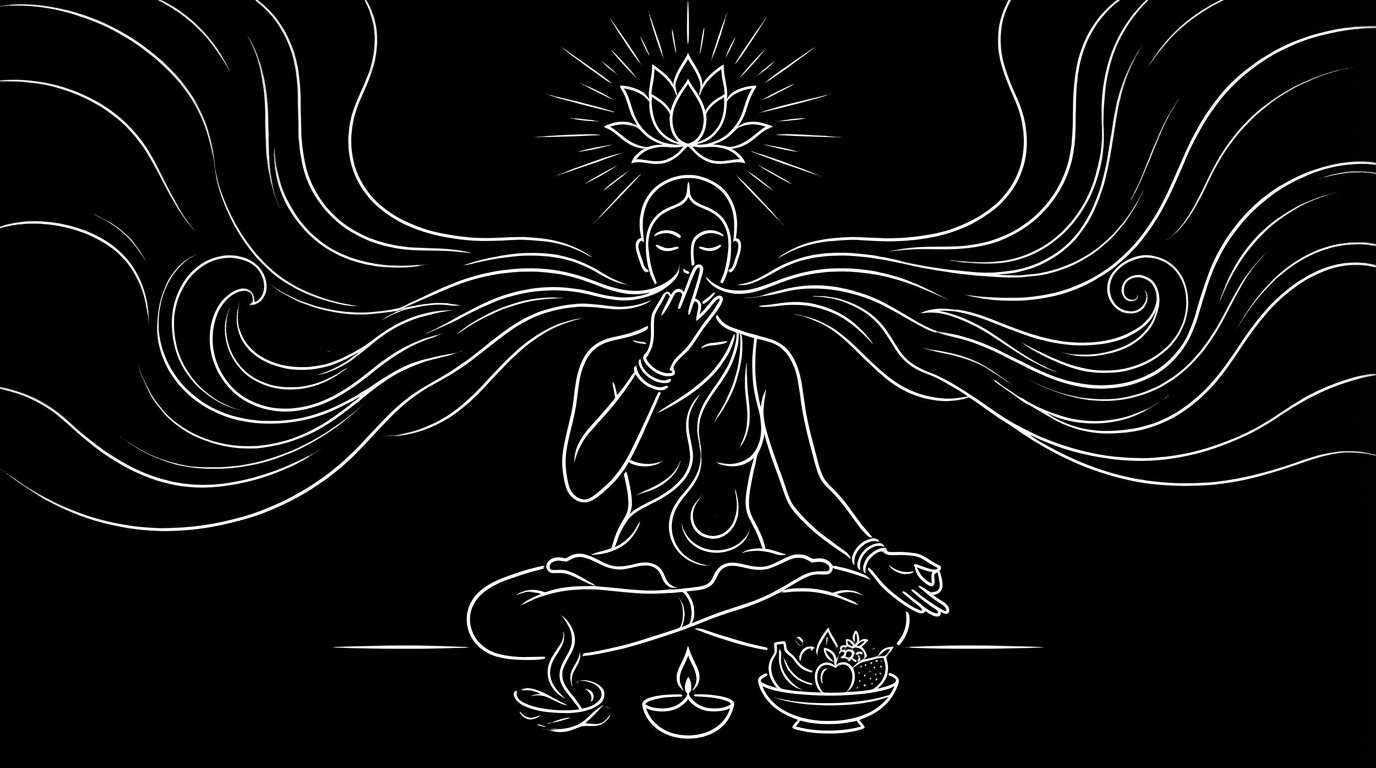
What is Anuloma Viloma?
Among the various breathing techniques that yogic tradition offers, Anuloma Viloma stands out for its elegant simplicity and profound effects. Also known as Alternate Nostril Breathing, this practice represents one of the foundational methods of pranayama, the systematic control and expansion of vital life force through conscious breathing.
The name itself offers insight into the practice's nature. "Anuloma" suggests moving with the natural grain or flow, while "Viloma" indicates moving against it. Together, they describe the alternating pattern that characterizes this technique, a rhythmic switching between nostrils that creates balance and harmony throughout your entire system.
Table of Contents
- Understanding the Practice
- The Science Behind the Nostrils
- How to Practice Anuloma Viloma
- Correcting Breathing Patterns
- Balancing the Brain Hemispheres
- Energy Channel Purification
- Mental and Emotional Benefits
- Building a Sustainable Practice
Understanding the Practice
At its core, Anuloma Viloma involves breathing through one nostril at a time while closing the other, then switching sides in a specific pattern. This isn't random alternation but a carefully structured sequence that directs the flow of breath, and with it the flow of vital energy, through specific pathways in your body.
The practice works with the concept of prana, the subtle life force that animates all living beings. While Western science recognizes oxygen as essential for life, yogic philosophy identifies prana as something more fundamental, a primordial energy that oxygen carries but isn't identical to. Pranayama techniques like Anuloma Viloma aim to absorb and direct this vital force through your body's subtle energy channels, called nadis, and into your energy centers, known as chakras.
When you breathe normally, without conscious direction, air flows through both nostrils simultaneously, though usually one side dominates. This dominance shifts naturally throughout the day in roughly ninety-minute cycles. Anuloma Viloma interrupts this automatic pattern, deliberately directing airflow through each nostril in turn. This conscious control creates effects that extend far beyond simple respiration.
The practice engages you completely. Your hand positions the fingers to control nostril opening and closing. Your attention tracks the breath as it enters and exits. Your awareness expands to notice the subtle sensations and energy movements that accompany each breath. This total engagement makes Anuloma Viloma both a physical practice and a moving meditation.
The Science Behind the Nostrils
Modern research has confirmed what yogic practitioners observed centuries ago: a fascinating connection exists between nostril airflow and brain hemisphere activity. When your right nostril dominates, your left brain hemisphere becomes more active. This left hemisphere governs logical thinking, analytical processing, language, and sequential reasoning. Conversely, when your left nostril takes precedence, your right brain hemisphere activates, bringing enhanced creativity, intuitive insight, spatial awareness, and holistic perception.
Throughout a normal day, this dominance shifts back and forth unconsciously. You might notice that during periods when you're engaged in analytical work, calculating numbers or writing detailed reports, your right nostril flows more freely. When you're creating art, listening to music, or daydreaming, your left nostril often opens more fully. Your body naturally adjusts nostril dominance to support whatever mental activity you're engaged in.
But modern life often disrupts these natural rhythms. Stress, poor posture, environmental factors, and habitual breathing patterns can create imbalances. One nostril might remain chronically more open than the other. One brain hemisphere might dominate excessively, leaving you either overly analytical and rigid or scattered and unfocused. These imbalances manifest as various physical, mental, and emotional difficulties.
Anuloma Viloma addresses these imbalances directly by consciously equalizing airflow through both nostrils. You're not leaving the balance to chance or to automatic processes that might be malfunctioning. You're taking deliberate control, ensuring that both nostrils, and by extension both brain hemispheres, receive equal stimulation and activation. This creates a state of equilibrium that affects every dimension of your functioning.
How to Practice Anuloma Viloma
The practice begins with proper positioning. Sit comfortably with your spine erect, either in a cross-legged position or on a chair with your feet flat on the floor. The key is maintaining an upright posture that allows free breathing while remaining relaxed enough to sustain the position for several minutes without strain.
Bring your right hand up to your face. Your thumb will control your right nostril, while your ring finger controls your left nostril. The index and middle fingers can either rest lightly on your forehead between your eyebrows, or fold down toward your palm, depending on which variation feels more natural. This hand position, called Vishnu Mudra in some traditions, provides precise control while keeping your arm position comfortable and sustainable.
Begin by closing your right nostril with your thumb. Exhale completely through your left nostril, emptying your lungs fully. Then inhale slowly and deeply through the same left nostril, filling your lungs to comfortable capacity. Don't force or strain, just breathe smoothly and fully.
At the top of your inhalation, close your left nostril with your ring finger while simultaneously releasing your thumb from your right nostril. Exhale completely through your right nostril. Then inhale through this same right nostril, filling your lungs completely.
When your inhalation through the right nostril completes, close it again with your thumb while releasing your left nostril. Exhale through the left side. This completes one full cycle. The pattern continues: exhale left, inhale left, switch, exhale right, inhale right, switch, exhale left, and so on.
The breath should flow smoothly and quietly, without force or gasping. Imagine your breath as a continuous stream of water, flowing steadily without turbulence or interruption. Your attention follows this stream, riding the breath as it enters and exits, switches sides, and moves through your system.
Correcting Breathing Patterns
Most people develop problematic breathing habits without realizing it. Shallow chest breathing, holding tension in the abdomen, breathing primarily through the mouth, irregular rhythms, these patterns become so ingrained that they feel normal. But they significantly compromise respiratory efficiency and overall health.
Anuloma Viloma naturally corrects many of these issues through its structured approach. The practice requires you to breathe through your nose, retraining your system to use the nasal passages as they're meant to be used. Nasal breathing filters, warms, and humidifies incoming air, preparing it optimally for gas exchange in your lungs. It also produces nitric oxide, a molecule that improves oxygen absorption and has various beneficial effects throughout your body.
The alternating pattern encourages full, complete breaths. You can't rush through Anuloma Viloma the way you might rush through ordinary breathing. The switching between nostrils and the coordination required naturally slow your breath and deepen it. You become aware of how much air you're actually taking in, and over time, your capacity for full breathing increases.
The practice also reveals and addresses imbalances you might not have noticed. If one nostril feels significantly more blocked than the other, or if breathing through one side feels uncomfortable or strained, these asymmetries indicate issues that need attention. Regular practice gradually opens restricted passages and equalizes function between the two sides.
Perhaps most importantly, Anuloma Viloma teaches breath awareness. Instead of breathing mechanically and unconsciously, you develop intimate familiarity with your respiratory process. You notice subtle variations in how air flows, how your chest and belly move, how your energy responds to different breathing patterns. This awareness becomes a tool you can use throughout your day, catching and correcting dysfunctional patterns as they arise.
Balancing the Brain Hemispheres
The connection between nostril breathing and brain hemisphere activity creates fascinating possibilities for self-regulation. By consciously controlling which nostril you breathe through, you can influence your mental state and cognitive function in specific ways.
When you need to engage in logical, analytical work, you could emphasize right nostril breathing to activate your left brain hemisphere. Planning a project, working through mathematical problems, writing a detailed report, these tasks benefit from left brain dominance. Conversely, when you're engaged in creative work, intuitive problem-solving, or activities requiring holistic perception, emphasizing left nostril breathing activates your right hemisphere.
But Anuloma Viloma doesn't emphasize one side over the other. It equalizes them. This creates a state of integration where both hemispheres function optimally and work together harmoniously. You gain access to both logical analysis and creative insight. You can be both systematic and intuitive. This integrated state proves invaluable for complex tasks that require multiple cognitive modes.
The balancing effect extends beyond immediate cognitive function. Chronic hemispheric imbalance can contribute to various psychological difficulties. Excessive left brain dominance might manifest as rigid thinking, anxiety, or obsessive tendencies. Too much right brain activity without left brain balance could appear as scattered attention, emotional volatility, or difficulty with practical matters. Regular Anuloma Viloma practice gently corrects these imbalances, bringing you toward a center point where both modes of consciousness remain accessible and integrated.
Many practitioners report that this balancing creates a distinct quality of mental clarity. Thoughts become clearer but less compulsive. Emotions arise naturally but don't overwhelm. You feel more centered, more capable of responding appropriately to whatever situations arise. This isn't suppressing one aspect of yourself in favor of another, but rather allowing all aspects to function together in harmony.
Energy Channel Purification
From the yogic perspective, Anuloma Viloma's most significant benefit involves purifying the nadis, the subtle energy channels that network throughout your body. While anatomy texts don't recognize these channels as physical structures, practitioners consistently report experiencing them as tangible pathways through which energy flows.
The tradition identifies thousands of nadis, but three receive primary attention. Ida nadi runs along the left side of the spine, associated with cooling, lunar, feminine energy. Pingala nadi runs along the right side, carrying warming, solar, masculine energy. Sushumna nadi runs through the center of the spine, representing the unified state that transcends duality.
In most people, ida and pingala remain out of balance, with one or the other dominating. This imbalance manifests as various physical and psychological issues. When pingala dominates excessively, you might experience excess heat, agitation, aggression, or burnout. When ida dominates too strongly, you might feel lethargic, depressed, overly passive, or disconnected.
Anuloma Viloma works specifically to balance these two primary channels. By alternating systematically between nostrils, you ensure that both ida and pingala receive equal stimulation and activation. Over time, blockages in these channels dissolve. Energy begins flowing more freely and evenly. The system comes into equilibrium.
When ida and pingala achieve balance, something remarkable becomes possible. Sushumna, the central channel, opens. Energy that was previously oscillating between the two sides settles into the center. This centered state represents a higher level of integration, a transcendence of the dualities that ordinarily govern experience. Many advanced meditation practices aim specifically for this state, and Anuloma Viloma serves as direct preparation for accessing it.
Mental and Emotional Benefits
Beyond the physiological and energetic effects, Anuloma Viloma produces profound changes in mental and emotional functioning. The practice cultivates a quality of inner stillness that carries over into daily life. The mind becomes less reactive, less prone to getting caught in repetitive thought loops or emotional spirals.
Anxiety often diminishes significantly with regular practice. The slow, rhythmic breathing activates your parasympathetic nervous system, triggering the relaxation response. Blood pressure decreases. Heart rate slows. Stress hormones reduce. But beyond these measurable changes, something shifts in how you relate to anxious thoughts and feelings. They still arise, but they don't stick. They pass through more easily, like clouds moving across the sky.
Sleep quality typically improves as well. Many practitioners find that a session of Anuloma Viloma before bed prepares them for deep, restorative rest. The practice calms mental activity, releases physical tension, and creates the conditions for natural, healthy sleep. If you wake during the night, a few minutes of alternate nostril breathing can often guide you smoothly back to sleep.
Emotional regulation becomes easier and more natural. The balanced state that Anuloma Viloma creates extends to the emotional realm. You're less likely to swing between extremes, less vulnerable to being overwhelmed by intense feelings. This doesn't mean becoming emotionally flat or unresponsive. Rather, you maintain access to the full range of emotion while developing the capacity to experience feelings without being controlled by them.
Concentration and focus sharpen noticeably. The practice itself trains attention by requiring you to track your breath, coordinate your hand movements, and maintain awareness of subtle sensations. This attention training transfers to other activities. You find it easier to stay focused on tasks, less prone to distraction, more capable of sustained mental effort.
Building a Sustainable Practice
Starting Anuloma Viloma requires patience and gentleness. Begin with just a few minutes daily, perhaps three to five rounds when you first wake or before bed. This modest beginning allows your system to adapt without overwhelming it. Your nostrils might feel unaccustomed to controlled breathing. Your arm might tire from holding the hand position. These are normal adjustments.
As you develop comfort and facility with the basic technique, gradually extend your practice time. Add a few more rounds each week until you reach a duration that feels sustainable. Many practitioners settle into a practice of ten to fifteen minutes once or twice daily. This provides substantial benefits without requiring excessive time commitment.
The quality of your practice matters more than its duration. Five minutes of fully attentive, properly executed Anuloma Viloma serves you better than twenty minutes of distracted, sloppy breathing. Keep bringing your attention back when it wanders. Maintain smooth, even breaths. Ensure that your exhalations fully empty your lungs and your inhalations fill them comfortably but not forcefully.
Consistency produces the most significant results. Daily practice, even if brief, creates cumulative effects that occasional longer sessions cannot match. Your body and nervous system need regular reinforcement to establish new patterns. Daily practice also integrates the technique more deeply into your life, making it a natural resource you can draw on whenever needed.
Consider practicing at the same time each day. This regularity helps establish the habit and signals to your system that this is breathing time. Morning practice sets a calm, centered tone for your day. Evening practice helps you transition from activity to rest. Experiment to discover what timing works best for your schedule and temperament.
If you miss a day or several days, simply return to practice without self-judgment. The benefits of Anuloma Viloma don't evaporate because you skipped sessions. Just pick up where you left off and continue forward. Long-term consistency matters far more than perfect adherence to an ideal schedule.
The practice evolves as you develop. What begins as a somewhat mechanical technique gradually becomes more fluid and intuitive. You internalize the pattern so completely that your hand moves almost automatically, freeing your attention to notice more subtle dimensions of the experience. You might begin sensing energy movement, feeling how the breath affects different parts of your body, experiencing states of consciousness that arise naturally from balanced breathing.
Anuloma Viloma offers a gateway into the deeper dimensions of pranayama while remaining accessible enough for complete beginners. It requires no special equipment, no unusual flexibility, no esoteric knowledge. Just your breath, your hand, and your attention. Yet this simple practice can transform your relationship with breathing, with your own mind, with the fundamental life force that sustains you. Start simply, practice regularly, and allow the balancing breath to work its subtle magic in your life.